
Five Ways to Stand Out
You can compete on functionality, service, quality, price, or focus. Pick one. Maybe two. Trying to win on everything means losing on everything. Excellence in one dimension beats mediocrity in five.

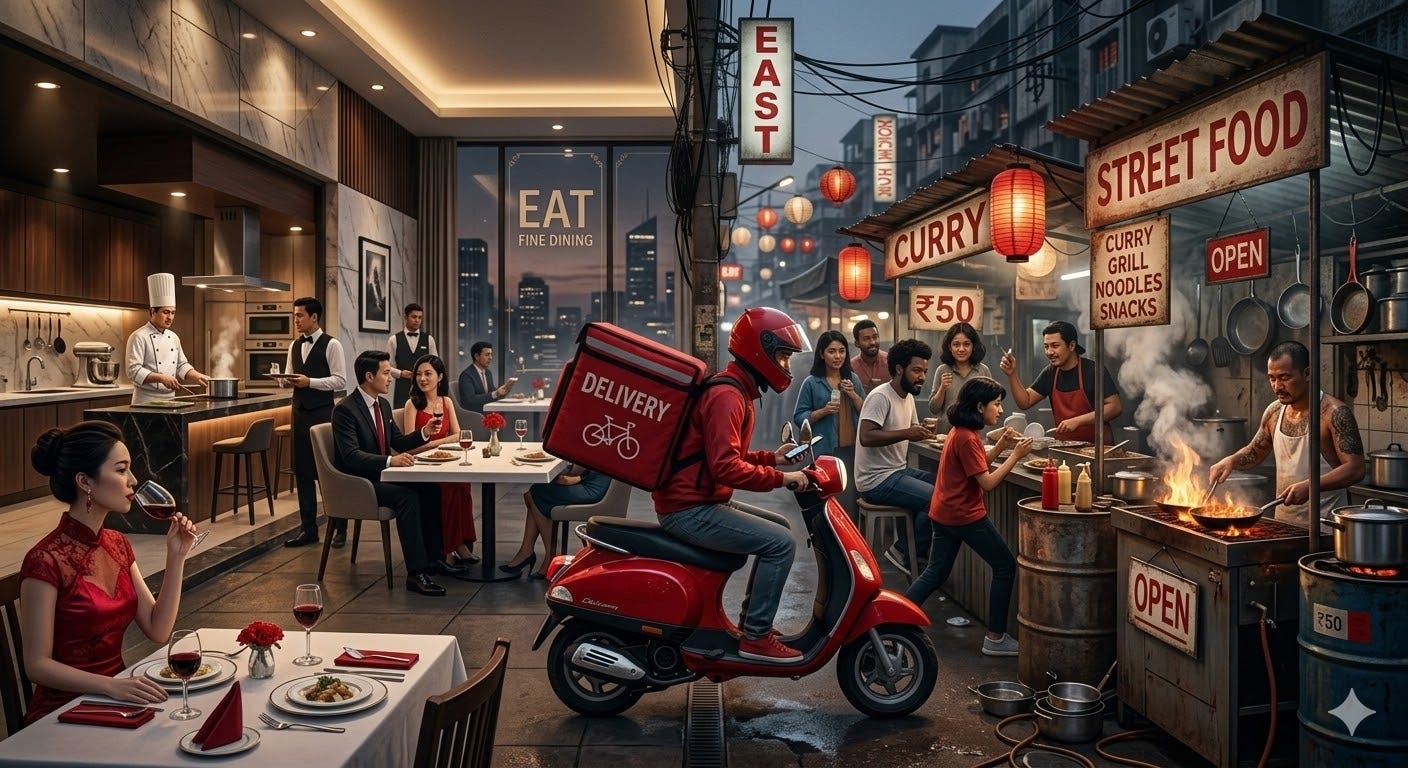
When Foodpanda and HungryNaki dominated food delivery in Dhaka, we looked at what they were doing and made a decision that felt almost too simple. We were not going to fight them on their turf.
Their turf was Gulshan restaurants, 500-taka salads, Thai fusion, imported sushi. Glossy apps. Formal restaurant partnerships. Weeks of negotiation, contract signing, POS installations, API integrations. They were built for customers who didn’t flinch at delivery fees that cost more than the meal itself.
Our customer wanted Star Kabab. Biryani in a paper box. Tehari ladled out of an aluminum drum the size of a small child. Food that was fast, familiar, and under 200 taka total. No one was serving them. Not seriously. Not with any respect.
So we didn’t build a better Foodpanda. We went the other direction entirely. Our riders walked into restaurants, took photos of laminated menus and handwritten chalkboards, and our interns manually typed them into the system. No contracts. No negotiations. No onboarding. If a restaurant served food, it was on Pathao. When an order came in, the rider walked up like any regular customer, paid, waited, picked it up, and delivered it. The restaurants had no say. They couldn’t stop us. Within weeks, while competitors were still onboarding their fifth premium restaurant, we had thousands of eateries. We were the first delivery app to offer Star Kabab. How do you operate in Dhaka and not offer Star Kabab? That single decision, to focus on a completely different customer rather than compete for the same one, did more for Pathao’s food business than any feature we built or campaign we ran.
But I want to be honest about something, because I’ve lived both sides of this. The instinct when you face competition is not to choose. It’s to do everything. Better app, lower prices, more restaurants, faster delivery, bigger call center. You don’t make that decision because you’re stupid. You make it because the pressure to show growth across every metric is relentless. Investors ask why your average order value is lower than the competitor. Board meetings turn into comparison exercises. And in Bangladesh specifically, there’s a cultural layer on top of all of it: you never want to appear weak. Saying “we’re not going after that segment” sounds like an excuse. Like you can’t. Like you’re afraid. So instead of a deliberate strategic choice, you frame it as “we do everything, we’re just better at this part.” That framing is the trap. It’s not a strategy. It’s insecurity dressed up as ambition.
The result is that you spread so thin you become mediocre everywhere. You’re not winning on price because your costs are too high from doing too much. You’re not winning on quality because you’re moving too fast to fix anything. You’re not winning on focus because you can’t say no. There are five real ways to beat a competitor. Price. Quality. Service. Functionality. Focus. That’s the whole map. Every company that ever won a crowded market picked one or two and went so deep that competitors couldn’t follow without abandoning everything they’d already built. Southwest chose price and redesigned their entire operating model around it. No assigned seats. No frills. Just cheap and on time. When bigger airlines tried to copy them with budget sub-brands, they found out that cheap isn’t a pricing decision, it’s a cultural commitment you either make all the way or not at all. Netflix didn’t beat Blockbuster on everything. They beat them on one thing: no late fees, to your door. That was the wedge. Spotify didn’t out-quality iTunes. They changed the axis entirely, from ownership to access. One idea, total conviction.
We did the same thing with bikes before we ever figured it out with food. When we launched motorcycle rides in Dhaka, we weren’t offering a premium experience. The bikes were basic, the app was rough, the experience was chaotic. What we offered was something nobody else was offering at all: a way to beat Dhaka traffic on two wheels, at a price that actually made sense for the people stuck in it. We weren’t better than Uber. We were pointed at a completely different problem. Pick your axis. Then build everything around that one promise. Your pricing, your hiring, your product decisions, your pitch to restaurant owners with chalkboard menus.
The companies that try to win on all five end up losing on all five. You don’t need to be the best overall. You need to be undeniable in one place.