
Pricing Like You Mean It
Being the cheapest is usually the hardest path to success. Price for value, not volume. Your pricing sends a signal about what you think your product is worth. Make sure it's the right signal.

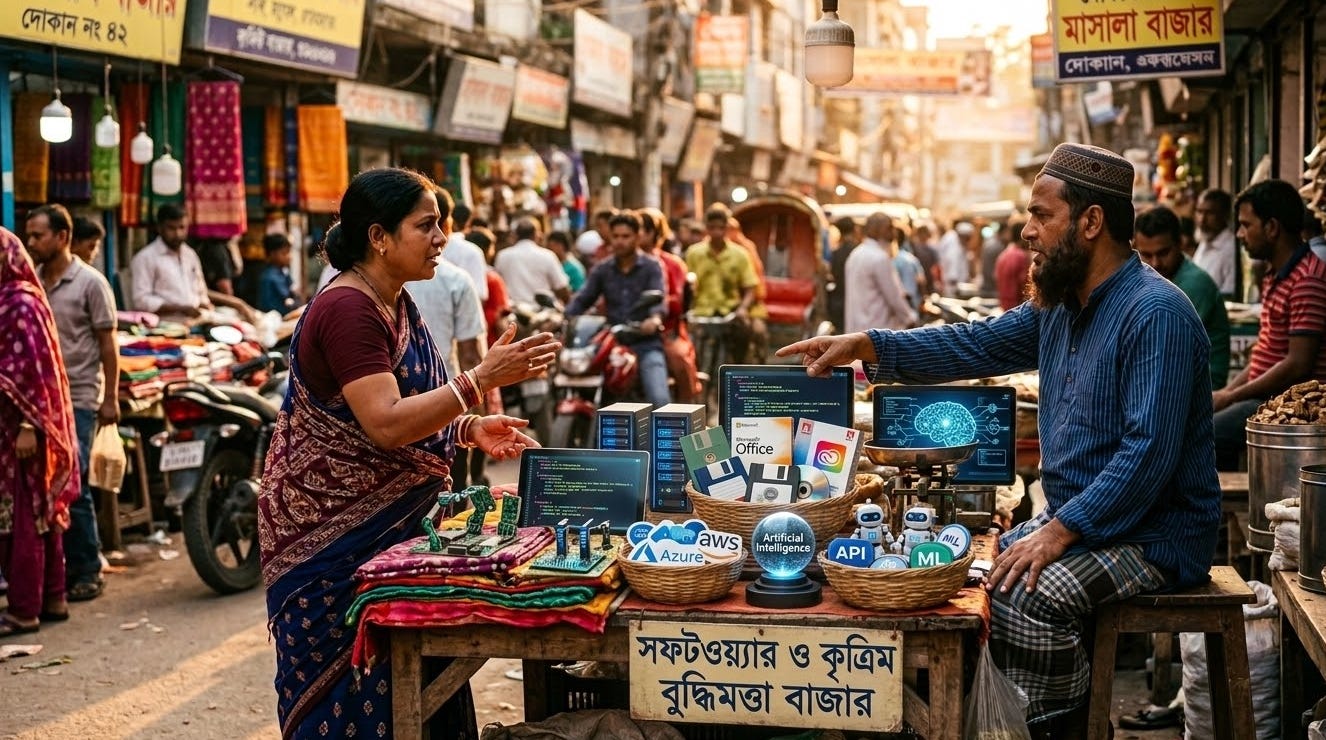
There’s a particular kind of meeting that happens in every startup in Bangladesh. Someone in the room, usually the most eager person there, makes the suggestion: “Let’s just go cheaper than everyone else. That’s how we win.”
It sounds logical. You are a new company. Nobody knows you. The fastest path to getting people through the door is to make the price impossible to refuse.
And that logic will quietly kill your company.
Cheap is not a strategy. It is a panic response dressed up as a plan. The moment you compete on price, you have accepted a race you cannot win, because there will always be someone willing to lose more money than you to beat you. Price is not just a number. It is a statement about what category you belong to, what customer you are designed for, and how seriously you take your own product. Get it wrong, and no amount of great execution will save you.
The Signal You Don’t Know You’re Sending
When Netflix launched in 1997, it did not try to out-cheap Blockbuster. Blockbuster had the stores, the catalog, the brand. If Netflix had just been a cheaper version, it would have died in the comparison.
Instead, Netflix charged $15.95 a month for unlimited rentals with no late fees. Not cheap. But precise. It removed a specific pain customers already knew they had. The price was not the reason to sign up. The price was the proof that Netflix understood the problem.
Your pricing communicates what problem you solve. Not in a brochure. Right there, in that number. If you charge too little, you signal that the problem is not that serious, or that you do not fully believe in your solution. In Dhaka especially, founders assume that low prices equals accessibility equals growth. But accessibility without perceived value creates a customer who tries your product once, does not take it seriously, and never comes back.
The Bangladesh Bazaar Problem
There is a cultural dimension to this that nobody talks about honestly. In Bangladesh, negotiation is woven into everything. At Karwan Bazar, nobody pays the first price for hilsa. At New Market, the tailor’s opening quote is a starting position, not a final offer. Bargaining is not rudeness here. It is how trust is established, how both sides signal they are serious. When your grandfather haggled over a piece of land in Narayanganj, the back and forth was the contract.
This creates a brutal problem for any startup that prices a digital product.
Your early customers will apply bazaar logic to your SaaS subscription or your service fee. They will ask for a discount. If you give it, they will ask for another. Somewhere in that spiral, you stop being a product they respect and become a vendor they manage. The price floor collapses, and suddenly you are running a charity with a login page.
I watched this happen to founders I knew personally. A logistics SaaS company, genuinely good product, spent eight months negotiating custom deals with every enterprise client. Every client got a different price. When the founder tried to standardize a year in, customers who had been paying discounted rates felt cheated. Three of them left. Revenue went backwards before it went forward.
The way through this is not to refuse the conversation. It is to redirect it. When someone asks for a discount, the question you answer is not “how low can I go?” It is “what value are you not seeing yet?” A tailor on Mirpur Road who knows his stitching is different does not drop his price when someone haggles. He picks up the hem, shows the finish on the inside seam, and explains why it lasts three years instead of one. The price holds because the value is visible. Your job is to make the value that visible, every time.
The Founder Who Held the Line
I know a founder in Dhaka who built a B2B HR software company. When he launched, the market expectation was for something cheap, practically free, because that was what the two competitors before him had trained the market to expect. Both of those companies had burned out quietly, unable to sustain the economics.
He priced at three times what the market expected. Prospects pushed back immediately. Some walked out of meetings. His own team internally questioned whether the number was too aggressive. For the first four months, he closed almost nothing.
He did not move the price. Instead, he sharpened his pitch. He started calculating and presenting the actual cost of manual HR processes for each prospect, in taka, per month. Time spent, errors made, compliance risks carried. Then he put his software’s monthly fee next to that number.
By month six, he was closing consistently. His customers were not price-sensitive buyers who had reluctantly settled. They were convinced buyers who understood what they were paying for and why. Two years later, his retention rate was above 90 percent. His competitors had come and gone. He was still standing, with margins that let him actually build the product.
His customers chose him because he was expensive. The price told them he was serious.
What Happens When You Have to Raise Your Prices
bKash launched in 2011 trying to solve a genuinely hard problem: moving money in a country where most people had no bank accounts. To get people onto the platform, they made the pricing nearly invisible. Cash-in was free. Sending money was negligible. The friction of cost was removed so that the harder friction of behavior change, getting people to trust a phone with their money, could be the only battle being fought.
It worked. bKash became infrastructure. Then, slowly, the fees came. Cash-out charges increased. Transaction fees appeared across services. The backlash was real and loud. But almost nobody left.
Because by the time bKash raised prices, the switching cost was enormous. Your family sends money on bKash. Your landlord expects bKash. The pharmacy takes bKash. The network was so embedded that the price correction was painful but not fatal.
This is the only responsible version of the “start cheap, raise later” strategy: you must build something so essential that when the price correction comes, the cost of leaving is higher than the cost of staying. The mistake founders make is assuming they can replicate this with a product that lacks bKash’s lock-in. If your product is not becoming infrastructure for your customer, you will never raise the price without losing them. You will have trained them to expect cheap forever.
Free is Not the Same as Cheap
When OpenAI launched ChatGPT for free in late 2022, it hit a hundred million users in two months. That free tier was not charity. It was a distribution strategy. The product itself was the marketing.
But free is not a business. So ChatGPT Plus launched at $20 a month, a deliberate premium signal. Millions subscribed because the free tier had already proven the value. Now OpenAI is exploring advertising for its free users, the same architecture YouTube built: free with ads for the mass market, paid without ads for people who value their time, and creator monetization as a third layer entirely.
This is what sophisticated pricing actually looks like. Not one number chosen in a meeting. A system designed around different levels of willingness to pay. Most founders price their product once at launch and never revisit it. That is not pricing. That is guessing.
Set the price. Defend the price. And treat it like a product, something that ships, gets feedback, and improves.