

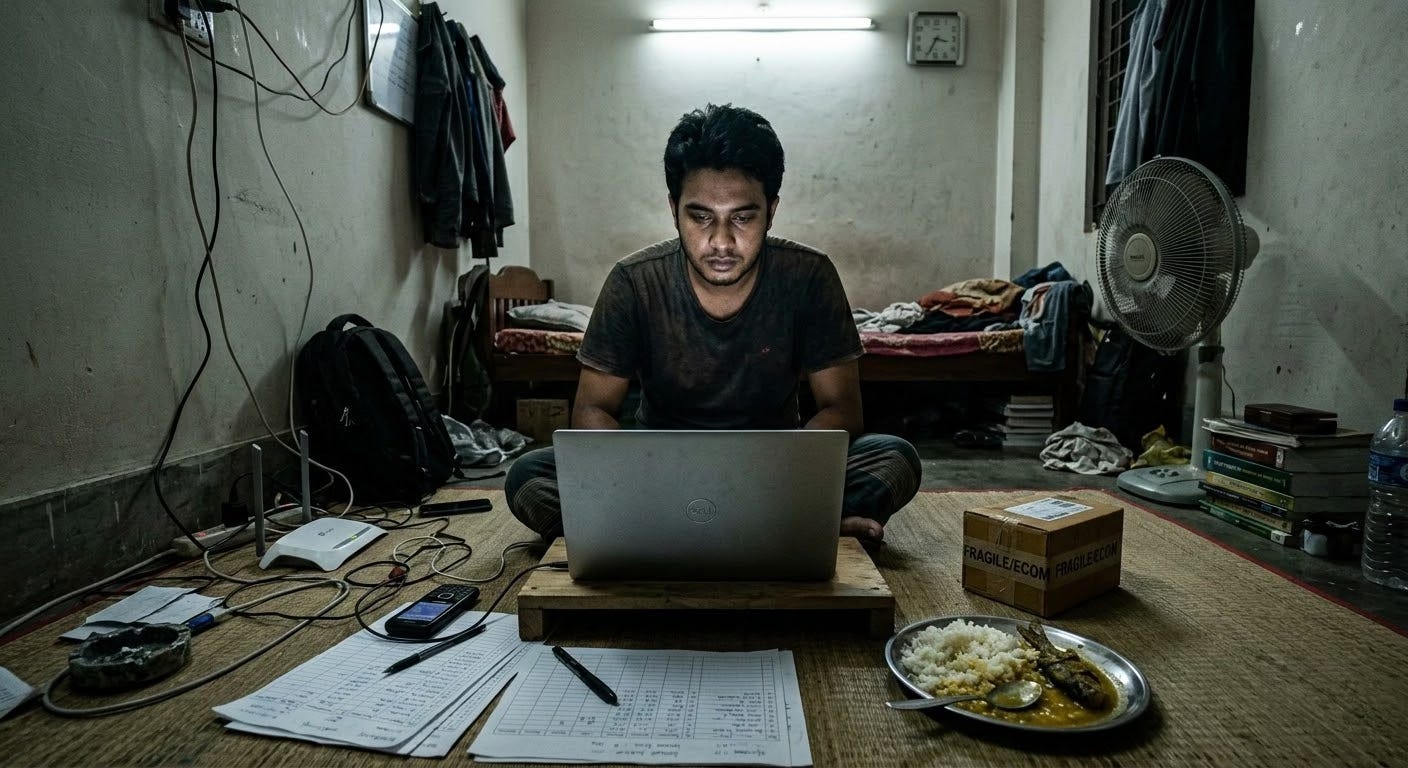
The first order we ever got at Pathao felt like a miracle. I paced the room, called the rider three times, refreshed my phone until the delivery was confirmed. I told myself: we’ve cracked it.
Then nothing happened for a week.
Orders trickled in ones and twos after that. My riders would message me carefully, almost apologetically: “Bhai, kichu delivery ase?” The spreadsheet barely moved. We had three riders, one in Uttara, one in Dhanmondi, one in Mirpur, and most days they had nothing to do. No dashboards. No algorithms. Just me, a hundred browser tabs, and a prepaid SIM I kept topping up. Pathao, as we had imagined it, was dying quietly.
Here’s what I didn’t understand then: a first order isn’t traction. It’s proof of life. It confirms the mechanics work. It tells you nothing about whether a market actually wants what you’ve built.
The Moment That Rewired Everything
The call that changed everything came from a woman named Poter Bibi. She ran a small clothing store on Facebook and wanted 20 deliveries. Our biggest order yet. She negotiated our 120-taka price down to 60, and I folded immediately because I needed the business more than she needed us.
Then she said something I wasn’t expecting: “I don’t need instant delivery. Just make sure it gets there within two days.”
We had been building a same-day, on-demand service because speed felt like the obvious value. But Poter Bibi didn’t want speed. She wanted reliability. She was one of thousands of Facebook merchants in Bangladesh operating without a functional logistics layer under them. Traditional couriers were slow, unreliable, and built for the wrong era. She just needed someone who would actually show up.
That single sentence exposed a market we’d been standing next to without seeing. Facebook commerce was exploding across Dhaka. Small sellers moving clothes, cosmetics, phone cases, and half of them had no dependable way to get their products to customers. Once we understood that, we stopped pitching on-demand delivery and started calling every online shop we could find. Orders went from one a month to 50 a day.
Airbnb’s founders had a version of this same moment. They thought they were building a cheap place to sleep during conferences. What they discovered, only after doing it manually in New York and sitting with actual hosts and guests, was that they were really selling the feeling of belonging somewhere rather than just staying somewhere. The product they launched wasn’t the product that scaled. The insight that scaled came from staying close enough to customers to hear what they actually valued.
Validation Is Behavioral, Not Verbal
The BRAC University experiment was even more instructive about what validation really is.
We had a small fleet of bikes sitting idle in the afternoons, costing us money between the 11am-4pm delivery window. So we created a Facebook group. No app, no backend, no investor pitch. Just a group, everyone in my contacts, a simple post: “Need a ride? We have bikes. Cheaper than a CNG, faster too.”
Standing outside BRAC in the heat with flyers, pitching students. Most ignored us. One girl asked if the driver would kidnap her. We told her a CNG was more dangerous because you couldn’t jump out. She wasn’t convinced.
But a few tried. When the ride finished in five minutes instead of thirty, something shifted on their faces. They came back the next day. They brought friends. A post went up in a student Facebook group. My phone started ringing from numbers I didn’t recognize: “Are you the guy with the bikes?”
That’s what validation looks like. Not someone saying “great idea.” Not a survey. Not friends being polite. Strangers, with no reason to be generous, choosing your product and then coming back and telling other strangers about it. That’s the signal. Everything before it is just noise.
Uber didn’t validate ride-sharing through market research either. Travis Kalanick and a few friends quietly tested black car rides in San Francisco at New Year’s Eve 2009. No app, no branding. Just a text to a phone number. When those early riders kept asking “when can we use this again?”, that was the proof. The company they then built was answering a question the market had already answered for them.
What You’re Actually Looking For
There is one signal that cuts through everything else: does demand exist without you forcing it?
When riders started showing up at our training center without being recruited, asking how to join, that was the signal. When Gojek noticed us without a formal pitch, that was the signal. When the courier business revived itself during COVID, not through a campaign but because merchants desperately needed it, that was the signal.
The hard truth is that most founders mistake their own excitement for market demand. They launch, get some polite interest from their network, call it validation, and start scaling. Then they discover the demand was borrowed, not built.
Real validation is unglamorous. It happens in a Facebook group. On a campus sidewalk in 35-degree heat. On a phone call with a woman who negotiates your price in half before she’ll even try you. It happens in the gap between what you thought you were building and what the customer tells you they actually need.
The market always tells you the truth. You just have to be humble enough to hear it.