

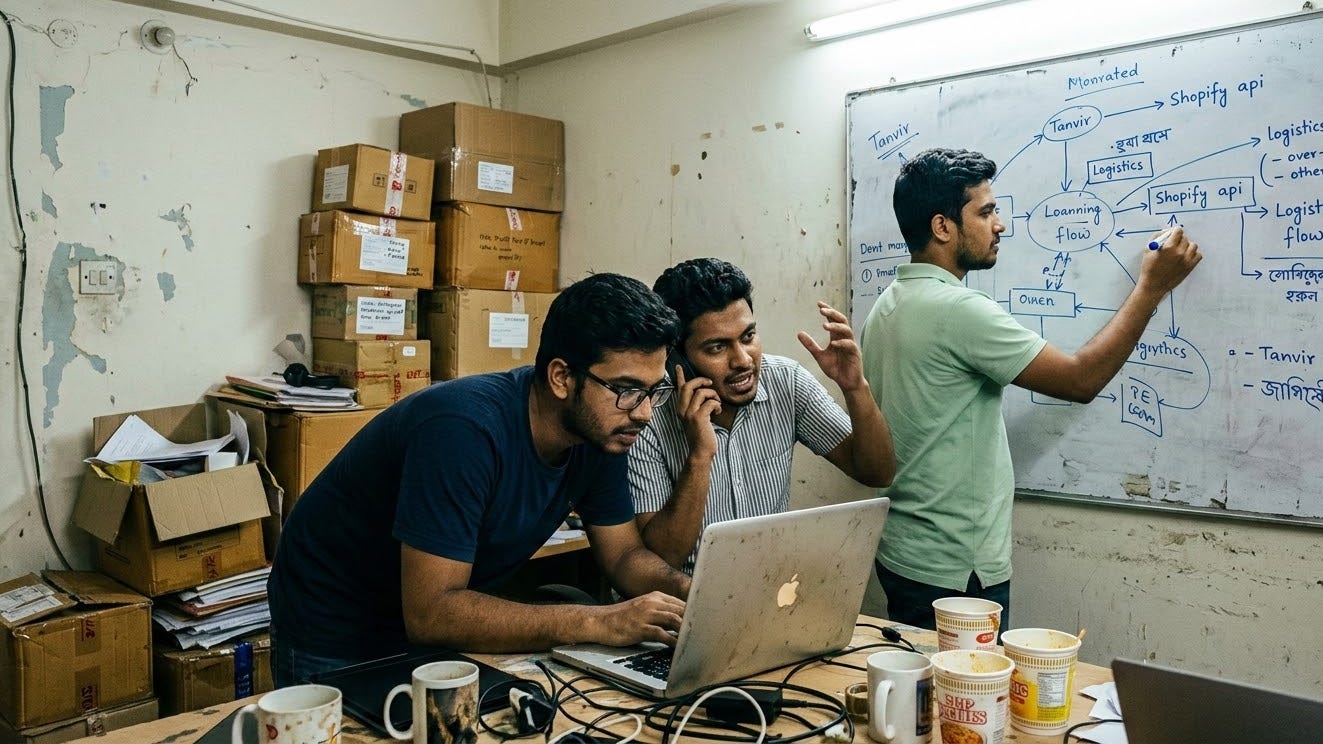
The first few months at Pathao, nobody had a title. We didn’t have business cards or org charts or reporting lines. We had a shared Google Sheet, three laptops, and an overwhelming conviction that we were going to figure this out. Adnan was writing code. Riaz bhai was on the ground talking to riders. I was doing everything else, which meant I was doing nothing particularly well.
It didn’t take long to realize the problem. Not that we lacked skill, but that we lacked clarity. When you don’t define who owns what, nobody truly owns anything. The product had bugs that nobody was officially responsible for fixing. The driver onboarding was broken because nobody had formally claimed it. We were all vaguely responsible for everything, which is another way of saying we were each fully responsible for nothing. Three people running in slightly different directions is just as bad as running in no direction at all.
So we had the conversation. Not about titles, but about territory.
Titles Are Costumes. Accountability Is the Real Job.
Here’s what nobody tells you about a three-person founding team: the org chart doesn’t matter. Nobody cares that you’re the “Chief Operations Officer” when there are exactly three people in the company and one of them is also handling vendor negotiations. What matters is the answer to a much simpler question: who is going to make sure this specific thing doesn’t fall apart?
That’s it. That’s the whole framework.
At Pathao, we landed on something loose but functional. Adnan owned the product and the technology. What lived inside the app was his domain. Riaz bhai owned the supply side, driver acquisition, and street-level operations. I owned everything facing outward, investors, partnerships, strategy, and the general chaos of keeping the company moving forward.
It wasn’t perfect. It overlapped constantly. But it was clear enough that when something broke, we knew who the first phone call went to. That clarity alone changed how we worked.
Ownership Is a Posture.
Here’s where most founding teams get it wrong. They confuse having a role with having a limit. They assume that because Adnan owned the product, I didn’t need to understand it. Or that because I handled investors, Riaz bhai didn’t need to care about the pitch narrative.
Wrong. Dangerously wrong.
Every founder needs to own everything, even the things that aren’t theirs to execute. This isn’t about micromanaging your co-founders. It’s about the psychological posture you bring to the company every day. When a driver complained that the app crashed during peak hours, that was Adnan’s problem to fix, but it was also my problem, because it affected retention, which affected our investor metrics, which affected our runway. Ownership without boundaries is what separates founders from employees.
This posture gets tested hardest when the company is under physical stress, not just strategic stress.
During one of our early delivery surges, our fleet was completely overwhelmed. Orders had spiked, riders had called in, and there was simply nobody left to run the remaining parcels. I had a meeting in the afternoon and a call with a potential partner in the evening. I cancelled both. I put on a backpack, loaded it with packages, and spent the next several hours delivering around Dhaka on a bicycle.
I want to be precise about how that felt, because the memory is still sharp. It wasn’t heroic. It was hot, sweaty, and the addresses were hard to find. One customer kept calling me to ask where I was, as if my description of “two minutes away” somehow made traffic disappear. Another one wasn’t home after I’d ridden thirty minutes to reach them. I sat outside their building and waited.
Here’s what that afternoon gave me that no strategy meeting ever could: I understood, viscerally, what our riders dealt with every single day. The bad addresses. The customers who didn’t pick up. The weight of the bag on your back after four hours. When I got back and started thinking about onboarding improvements, about fleet incentives, about why our completion rates were lower than they should be, I was thinking from the inside out. Not from a dashboard.
No job is too small. That’s not a motivational poster. It’s a rule of survival. When the company needs something done and nobody else can do it, you do it. The moment a founder treats certain work as beneath them is the moment they start losing touch with the company they’re building.
Builders and Sellers: Know Which One You Are
There are two fundamental jobs in every early-stage company. Building the thing, and convincing the world the thing matters. Everything else is support work for one of those two functions.
Understanding which one you are, naturally, is the first act of accountability. Not because you’ll only ever do one, but because knowing your default wiring helps you recognize when you’re operating outside it, and why that’s sometimes exactly what the company needs.
Here’s a rough test:
You’re probably a Builder if:
You get more energized shipping a feature than closing a deal
Your instinct when something breaks is to fix it yourself
You think in systems, flows, and edge cases
Ambiguity energizes you when it’s technical, exhausts you when it’s social
You’d rather show someone a working product than describe it
You’re probably a Seller if:
You get more energized from a handshake than a deployment
Your instinct when something breaks is to manage the narrative around it
You think in relationships, incentives, and timing
You can walk into a room of strangers and leave with commitments
You’d rather describe a vision so clearly that someone can feel it
But here’s the problem: in the early stage, you don’t get to just be one. You have to be both, badly and simultaneously, until you can afford to hire the version you’re not.
I wrote code I’m not proud of. Adnan sat in merchant meetings he found excruciating. You do what the company needs, not what your job description says, because in a three-person startup, the job description is just “whatever isn’t getting done.”
The goal isn’t to become equally good at building and selling. The goal is to be self-aware enough to know which hat you’re wearing, and honest enough to know when to hand it off.
When Nobody Owns It, It Dies
About four months into Pathao’s operations, our driver onboarding was a mess. Drop rates were high. Drivers were arriving for registration and leaving confused. The process required paperwork we hadn’t fully thought through, and there were steps in the app flow that made no sense if you’d never owned a smartphone before.
Everyone knew it was broken. Nobody owned fixing it.
The problem lived in the gap between Adnan’s product work and Riaz bhai’s field operations. Each of them assumed the other had it. I assumed they had it. So it just sat there, bleeding quietly, costing us drivers we’d spent real money to acquire.
When we finally forced the question, who owns onboarding completion rates, the whole thing got fixed in two weeks. Not because we suddenly became smarter. Because there was now a person who went to sleep thinking about it and woke up accountable for it.
That’s the lesson. It sounds almost embarrassingly simple. But in the fog of early startup life, accountability gaps are where companies quietly die. Not in the big dramatic decisions, but in the unclaimed territory between roles.
Own your lane. And then own the lane next to it too. And when the fleet is overwhelmed and someone needs to strap on a backpack and go, own that too.