
First Who, Then What
Here's what the territory manager from the tobacco firm taught me about why pedigree is a trap.

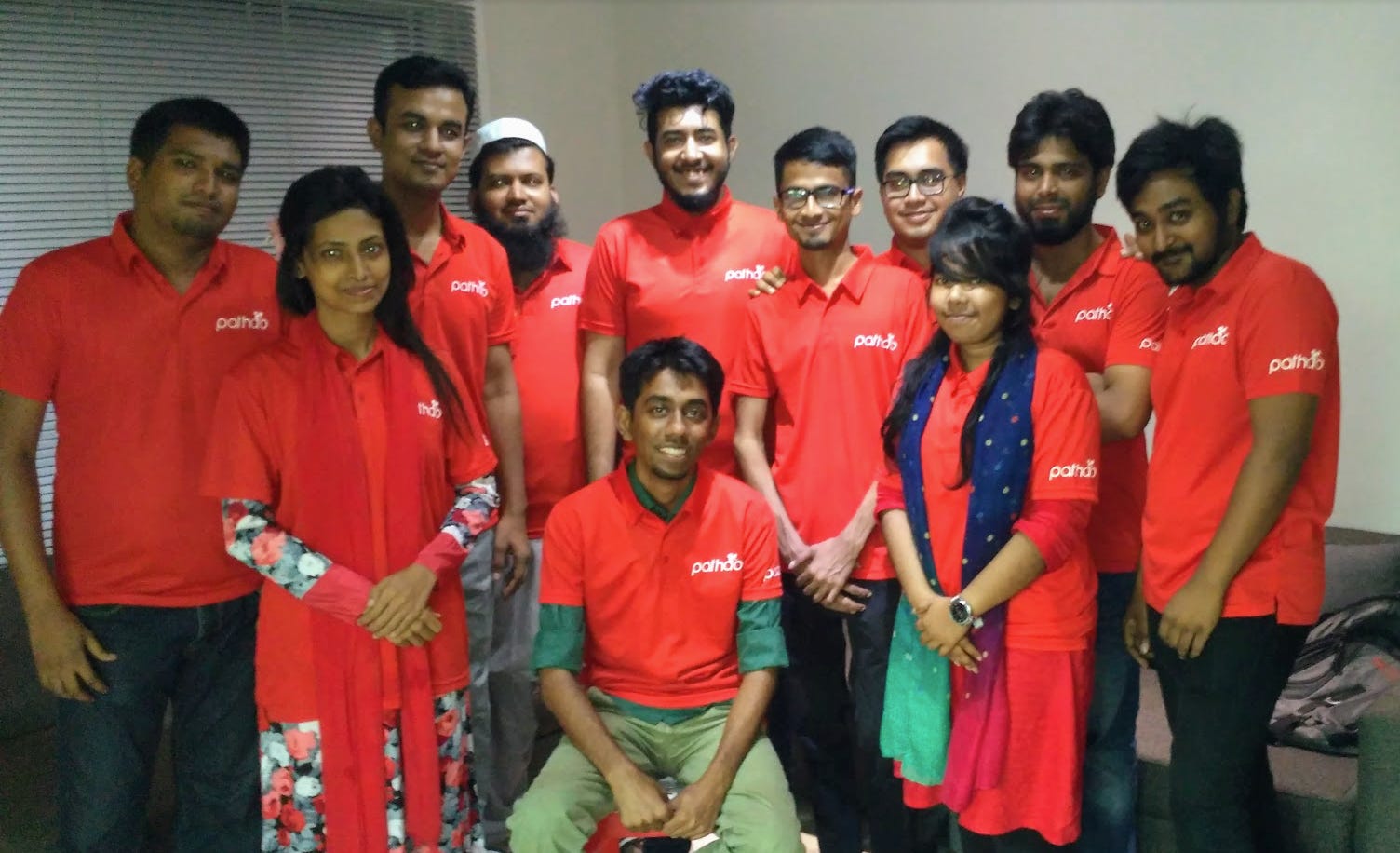
I had to dig up an old photograph for this post. An under-construction room in an under-construction building, all of us crammed in for the frame. We’re wearing our first branded Pathao shirts, red, ordered from the cheapest vendor we could find, the kind of red that bleeds in the wash. You can see in our faces that we hadn’t slept properly in weeks. I’d like to believe that you can also see our optimism. Nobody in that photograph knew what they were doing. But everyone in it had decided, in their own way, that they were going to figure it out.
I didn’t take a lot of photographs from those days. We were too busy working. But now I wish I did. Back then I thought Pathao was a logistics company. I thought the deck in my laptop bag, the one with the market sizing and the five-year projection, was the company. It took me three years and roughly twenty bad hires to figure out I had it backwards. The thing you build is downstream of the people you build it with. Get the people wrong and no plan survives contact with reality. Get the people right and they’ll rewrite the plan three times before lunch and the company will still be standing at dinner.
The Territory Manager from the Tobacco Firm
In 2017, when we were hiring twenty people a week, I made the most expensive hire of my life up to that point. A territory manager from one of the big multinational tobacco firms. Massive resume. Sharp shirts. Spoke in case studies. He got paid more than I did. I wasn’t even mad about it, I told myself that was the whole point. We desperately needed someone with more experience than any of us had. I was twenty-six. My head of operations was twenty-three. We had no idea what we didn’t know. This guy had run distribution networks across half of Bangladesh for a company that had been selling things in this country for longer than I had been alive. On paper, this was a steal at any price.
He lasted four months.
First week, he scheduled an all day meeting about vision and mission. Slide decks were prepared in advance. While we brainstormed brand pillars, our drivers in Mohammadpur were being ticketed by traffic police. Second week, an engineer messaged me asking whether the new hire was now his boss, because he’d been told to “loop him in” on every product decision. Third week, he was calling our riders “the field workforce”.
He wasn’t a bad person. He was an excellent operator. His default mode was to make a plan, present a plan, defend a plan, execute a plan. Ours was to do something, see what broke, fix it, do something else. Two different operating systems. Same machine. They didn’t run.
The cost wasn’t his salary, though that hurt. It was the trust the team lost in my judgment, because every one of them saw by week two what I refused to see until week sixteen. Netflix figured this out earlier than most. Reed Hastings introduced the keeper test. For every person on your team, ask whether you’d fight to keep them if they walked in tomorrow with another offer. If the answer is no, you already have your answer. The wrong hire isn’t dead weight. It’s a magnet. It pulls the company in a direction you didn’t choose. I should have fired him in week two. I fired him in week sixteen.
The lesson I missed was simpler than I wanted it to be. I hadn’t hired the wrong person. I had hired the right person for the wrong company. He would have crushed it at a sixty-year-old enterprise with stable distribution and quarterly planning cycles. He couldn’t function at a place where the answer to “what’s the plan” was “we’ll know by Thursday.” Pedigree is a signal about the system someone was trained in. It tells you almost nothing about whether they can work in your system.
Attitude Over Resume
Our first HR manager taught me the opposite lesson. I told him, day one, his job was to find me 100 riders. He blinked. Asked from where. I admitted I had no idea. He spent his time sifting through thousands of badly written CVs in bdjobs.com and bikroy.com, and having 20 meetings a day with blue collar workers checking if they are not creeps.
He treated “I don’t know how” as a starting condition, not a stopping condition. That’s the only variable that ever mattered. Two sentences: “I don’t know how to do that” vs “I don’t know how to do that yet, let me figure it out.” They look identical. They are completely different operating systems. The first ends a conversation. The second starts work.
The MIT-educated engineer who quit two months in when our staging environment kept crashing? Wall. The girl from a Bangla-medium school in Mirpur who taught herself SQL on YouTube in three weeks and went on to run our growth analytics? Information. The smartest people I’ve ever met failed at Pathao. The hungriest stayed and ran the company.
This matters more in Bangladesh than San Francisco for a reason. The default career advice from parents to children in Bangladesh is to find a a stable government job and never leave it. The whole society is wired to optimize for security. Which means the resume class, the pedigreed ones, are precisely the people trained from birth to flinch. They execute known plans beautifully. They collapse the moment the plan dies. And in a startup, the plan always dies.
Airbnb’s first hires were the inverse. Chesky famously asked candidates whether, if they had one year to live, they’d still take the job. Most said no. The yeses became Airbnb. Same filter. People who don’t need permission to be all-in.
Hire Slowly. Fire Fast.
Almost every founder says these words. Almost none of us practice them. Including me.
When you’re growing 100% month over month, slow hiring feels like a death sentence. We told ourselves we couldn’t afford to be picky. We were wrong. The cost of a slow hire is one missed week. The cost of a wrong hire, factoring the time you spend managing them, cleaning up after them, firing them, and the morale damage to everyone around them, is closer to a year. Slow hiring is the cheap option. It just feels expensive in the moment.
The reverse is also true. The moment you know someone is wrong, you already know. You don’t need another quarter. You don’t need another review cycle. You know in your gut, in the way you tense before your one-on-ones with them, in the way you find yourself doing their job. The reason we don’t act isn’t uncertainty. It’s discomfort. So we wait. While we wait, the best people on the team watch us wait, and lose faith.
The Bangladeshi cultural pressure on this is real. We’re a relational society. You don’t fire someone whose family knows your family, whose father called your father to thank you for the job. The whole social contract is wired against the clean cut. Founders here drift into the pattern of carrying the wrong people for years, paying with the morale of the entire company for the comfort of one conversation we don’t want to have. I did this. I’m not proud of it.
What eventually worked was crude. Every six weeks, the leadership team independently ranked our reports on two axes: contribution to outcomes, and contribution to culture. We’d compare lists. Anyone in the bottom of two or more was a candidate for a hard conversation. The point wasn’t the ranking. It was the calendar. Without a calendar, the conversation never happens.
What Right Looks Like
When we eventually shut down our customer support center in Rampura, the team leader who ran that floor asked one thing. He wanted to tell his own team before I did. I said no, it had to come from me, I owed them that. He said, with respect, I was wrong, because they wouldn’t believe it from me, and they needed to be able to ask questions only he could answer. He was right. I let him do it.
What he did next is the part I won’t forget. After the layoff, he stayed. Spent three weeks, on his own time, helping every one of his people find their next job. Called his contacts. Wrote recommendations. Coached them through interviews. Ninety people. He’d just been laid off himself. He didn’t have to do any of it. He did, because in his head, his job wasn’t over until his people were okay.
You can’t teach that. You can’t interview for it. You can only spot it after the fact, and build a company that produces more of it by hiring other people like that and protecting them when the machine tries to grind them down.
Amazon’s Day 1 doctrine isn’t really about being a startup forever. It’s about being run by people who behave like founders. The thing that compounds is the quality of the humans. Everything else is downstream.
I started Pathao thinking I was building a logistics company. I ended Pathao knowing I’d been building a team the whole time. The logistics was the byproduct. The team was the product. If I’d understood that on day one, I’d have spent half the time I spent on the deck and twice the time in the recruiting room. The bus is going somewhere. The road will turn ten more times before you get there. The map you brought will turn out to be wrong. What you have when you arrive is the people who got on the bus with you. Get the people right and you’ll figure out the road. Get the people wrong and the road won’t matter.